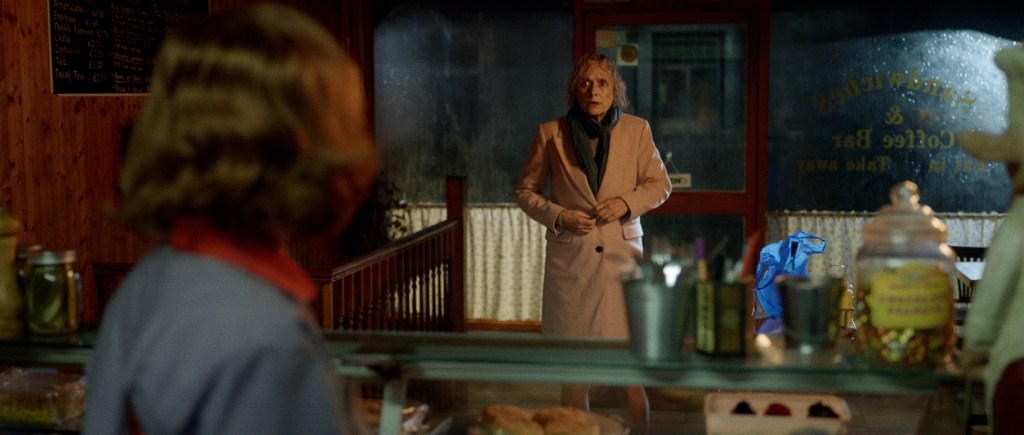
On a rainy night in London, Elle, a waitress in a small cafe, is confronted by a strange older woman in Jack Howard’s new short film The Second Time Around. The film has been receiving rave reviews and whilst it was showing at the Norwich Film Festival, I had the pleasure of chatting to director Jack Howard about the film, its influences and the power of cinema.
Firstly, a massive congratulations is in order. I adored this film. I’m interested in what drew you to the concept of second chances and how that inspired the film?
“I think it’s very interesting how people define what the film is about, because, I think that what I thought it was and what I intended to do hasn’t always lined up with how people have defined it, and I think that’s wonderful. I really like offering it to people and being like: ‘You tell me!’ I think that’s even more interesting. So it wasn’t even how you defined it. It wasn’t me thinking about second chances, but it certainly kind of morphed into that.
To me, the idea started from me being interested in those kind of high concept ideas and wondered if you could tell a story that used two people of the same gender to see if that could imply something about who these characters may be to each other. One that might be misinterpreted by the audience, but will be revealed later what is truly going on. And then it just kept growing and growing the more I kept asking questions about: Why would this happen? What would I do in that situation?
Caroline’s (Goodall) character in the script is referred to as ‘The Woman’, but there’s a little easter egg where her name is revealed, and it’s the name of my grandmother whom I lost when I was 5. I didn’t even hesitate to give her that name. I didn’t think about it until after the fact but I think that there was something in my subconscious bursting through, asking the question: What would you say to someone if you had five more minutes with them? That was kind of subconsciously going on without me even realising that was what I wanted to make the film about.”
And off the back of that, why do you think that we’re drawn to the concept of second chances? There’s lots of films in recent years that explore the concept and they end up becoming audience favourites, why do you think audiences are drawn to these stories?
“There’s so many conversations that are about: ‘if I just did this differently’ or ‘if I knew then what I know now’. I think that’s very human. And using the high concept at the centre of this film, almost teases you to think that if this time bending concept did exist, you could do something different. You could change it. And I was drawn to the idea that even if the concept existed, what if you still couldn’t change it? And you just had to accept it for the way that it was.
What was interesting to me was Caroline’s character coming into that cafe and hoping that she could potentially do something about it. But actually, over the course of the short time she’s there, understanding that she can’t, and having to accept things the way they are. It’s a fantasy to think about how you could change things, but, the important thing is to accept the reality of what has happened. I feel it’s a really powerful thing, that’s how you grow, by learning from these experiences and not wanting to change them.”
We’re always thinking ‘What if?’ and I think that’s the worst thing to think.
“I think so, because it’s literally impossible. That’s why it’s interesting to use the time-bending stuff where people think: ‘Oh I know how films like this work, Back to the Future, you can do that!’ but actually, the answer being no, it’s still impossible. That makes it more emotional, because it’s reflecting reality even though it’s using an impossible idea.”
“That’s how you grow, by learning from these experiences and not wanting to change them.”

Sticking to the theme, if you could go back to yourself before you made the film or in the early stages, what would you say?
“See this is interesting, because the answer is that this is the film it is because it got made the way it was made, in the time it was made.
But, I wish I could go back to myself a few years ago and try and tell myself to get out of my own way quicker. Because I really struggled with a lot of self-doubt, and the inner critic in my head was so loud. Especially coming from having primarily made comedy to then wanting to make something that stood shoulder-to-shoulder with the stuff I was inspired by. I was nervous that no one would care, or I wouldn’t be very good at it and there’s lots of those unhelpful things in the way until I thought f*ck it, I’m just gonna do it. Once I did that, I started feeling much better about it, and all of those things started to get quieter. So I think I’d tell myself to get to it sooner, and get out of my own way.”
In a continuation from that, you’ve been creating film content for over a decade, how does it feel to be on the other side, doing interviews, sitting in screens with audiences watching it and receiving nomination buzz?
“It feels fairly distant, because I really enjoy it when a person comes and tells me they like it. It’s nice to know it’s connected with a human being. But you’re right, I’ve been making stuff on the internet, like sketch comedy, short series and all that kind of stuff for years, and so you lose the personableness of it when it becomes data on a screen. It’s like 100,000 people watch i,t but it doesn’t mean anything because you’re just seeing the number.”
“It’s reflecting reality even though it’s using an impossible idea.”
I always prefer the cinema because it locks you in, I think the girl next to me was crying during your film.
“In the least sadistic way. I like that.”
I agree! It’s so lovely to experience the same film together, when I saw Hamnet at the film festival everyone was crying, it’s just not like watching from home.
“I think that’s it. There’s that wave that goes through everybody, when you can tell that everyone’s in the moment at the same time. I’ve always loved the moment at the end of my film where the music rises and it cuts to black; and there’s this kind of pause where nobody knows what’s happening next, and then the credits start. And it’s just always this bated breath in the audience. I’ve always loved that moment.”
I had that moment in Anora at the end, everyone just sat there in silence.
“And I think that’s something that I wanted to create to be honest. Going back to one of your first questions, part of me wanted to create something for that environment. I’m a child of a certain generation, so I can’t help that what happened when I was 16 was things like The Dark Knight, and a couple of years later Inception.
I can remember the cinematic experience of Inception more than I can remember most films. Just that ending where the music is trickling out and then it rises, just as the spinning top may or may not topple, then it cuts to black. I can just remember people gasping; we are collectively in that dream together for a second; where you are reacting to something on a screen, but in that moment, the frame bleeds away, and you are just in it.
So I really wanted to garner that kind of reaction from an audience, so it’s always far better seeing it in a cinema. And whilst it’s lovely to see the reviews on Letterboxd, seeing it at the Norwich Film Festival and hearing people’s reactions is ten times better.”
Nothing beats the cinema!
“Nothing beats the cinema, and you can quote me on that!”

We’ve touched on it a bit already, but as a film lover, were there any influences or nods to directors in the film?
“There are influences all over it. I really wanted to use the language of different genres to play with the audience’s expectations. So, to summarise it: I guess I wanted it to start as though you were watching Halloween, and then you realise you’re watching the diner scene from Moonlight.
So, Moonlight was a big reference. So was Arrival, specifically, the soundtrack in Arrival was a big influence on the music that my composer (Benjamin Squires) and I talked about a lot. The visual language of it is straight up from Osgood Perkins’ Longlegs, we used the same camera and lenses as they did to get the huge wide-angle lenses and the palette of it was also similar to that.
But also, Arrival having that kind of similar time-bending narrative, yet asking a very human question at the centre of it. Lost in Translation, also, because people ‘being’ is interesting to me and Eternal Sunshine of the Spotless Mind again, using high concept but to explore very relatable human experiences.
I mean, obviously, Christopher Nolan, from the way the movie ends and how I like to present my titles. Even the shot of the umbrellas in the box reminds me of the hats in The Prestige. I’m not taking anything, but all the things I like are being woven into this.”
In your behind-the-scenes video, you said you like your sets to be kind, collaborative and creative, was there anything you took from the cast and crew that made it into the film?
“It’s difficult because the set had to run so quickly that my memory of it is that I didn’t get to enjoy every moment of what we were creating. But honestly, I told my production designers (the Set Sisters) who created the look of the cafe, and my costume designer (Kathryn Poon) that I struggle with colours and I want you to talk to my DOP (Ciaran O’Brien) and you all figure it out. Because I knew I wanted that green and that slimy orange, yellow kind of stuff. But from there, you can create all of this.
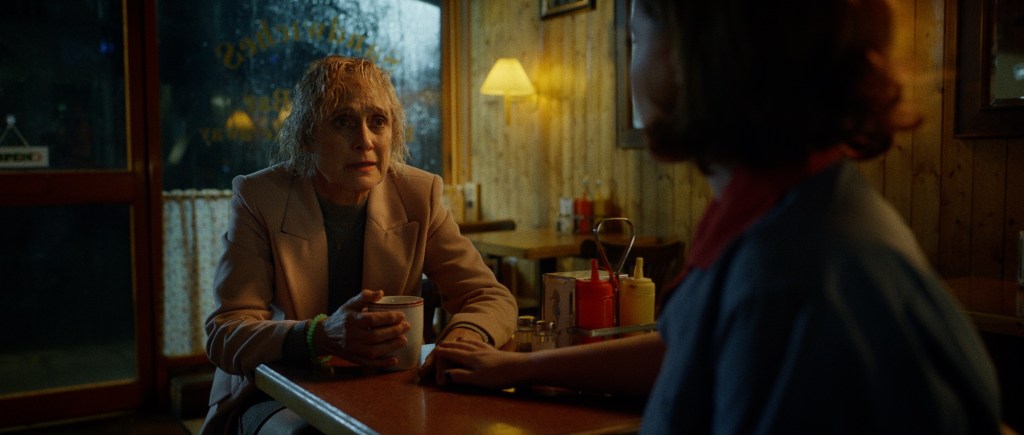
I think that the cafe feels kind of iconic, classic and recognisable. It feels like you’ve been there. And, I always knew I wanted Caroline’s character in a pink coat, but then Kathryn went out and found several options, and we picked the perfect ones for that. Specifically as well, Hannah’s (Onslow) waitress outfit, because in my head, I thought realistically, she’d probably be in black trousers and a white t-shirt, but I don’t think that’s interesting. So, what can we do? So that it doesn’t sway too far into American diner territory, but it still feels like she’s an iconic character that you could dress up as immediately, and she found the perfect thing.
I think allowing people who are really good at their jobs, especially in a project where you’re not paying them enough, to come and just do what they want. To be able to go, I’m giving you this, if you want to be involved in this, I want you to be involved in it. I want you to create as much as I’m creating. And, I think that inherently creates a very lovely environment, because people have ownership over what it is that they’re doing.”
The set is the heart of the film and it’s all filmed in one location, was it a streamlined process or were there any issues you had to navigate, filming in one location?
“There weren’t issues specifically because of the one location, although filming in a small working cafe became difficult to turn things around and in instances where the crew had to be in the kitchen or downstairs, all that is logistically time consuming and just kind of a bit laborious.
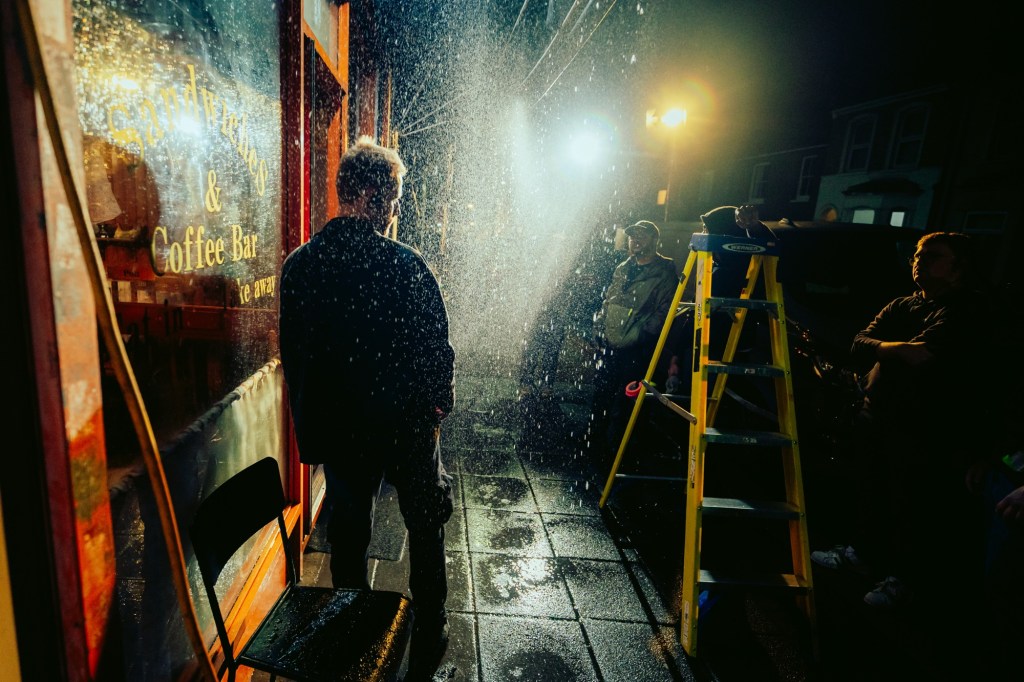
But the set did not run smoothly for reasons that were out of our control. On the first night of the shoot, the shot I was setting up of Caroline, where she’s at the door for the first time you see her, the rain machine broke mid take. I have that take, it’s captured a traumatic moment. It’s very strange to be able to watch that back. So our three-night shoot turned into a two-and-a-bit-night shoot, because for an 11-page script, three days was manageable and comfortable, but then all of a sudden it was like, ‘Oh no, we’re playing catch-up now.’ And I freaked out about it, certainly for a moment, I thought maybe it’s going to be bad now, maybe we’re not gonna be able to get everything we need to get. But I’m really pleased that my DOP Ciaran and I, who I’ve worked together with for probably nearing on 12/13, years. We just slipped back into this old teamwork way of working that we’ve done so many times, where it became me and him deciding on the fly what’s necessary and what’s unnecessary.
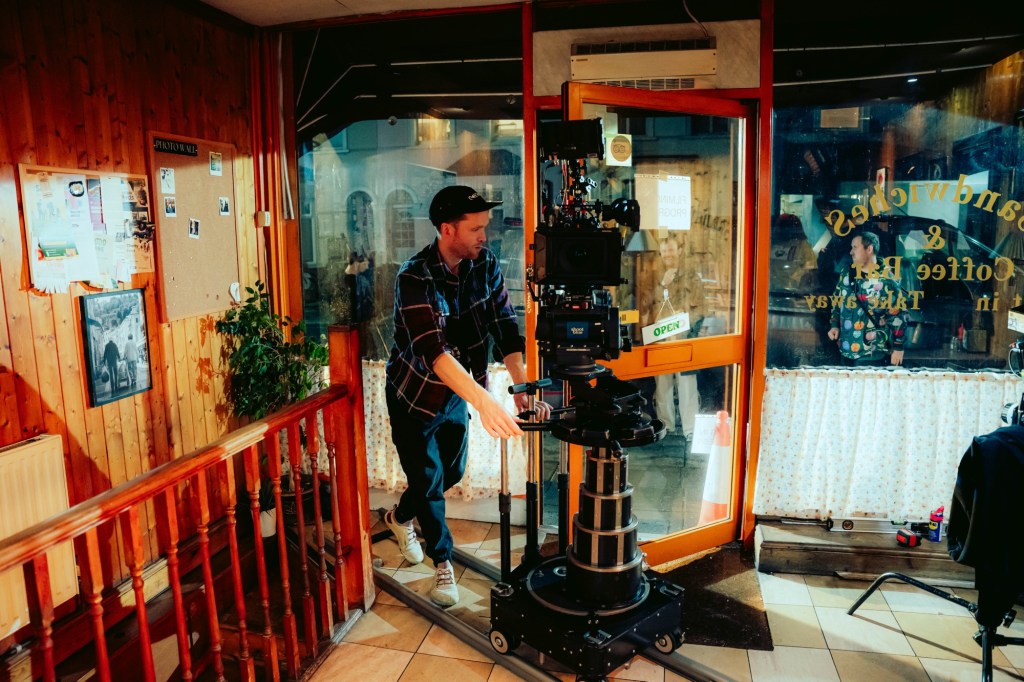
And when I watch the film now, I don’t feel like any of the stuff we had to cut back on, feels like it’s missing. And it feels nice that moments that we chose, for example, when Caroline’s character enters the cafe for the first time, it’s just this one mid shot that pulls back on a dolly that allows them to be in that moment for the 40 seconds that that scene takes. That was supposed to be covered a bit differently. It was supposed to certainly have more than one shot in it. But now I feel that was the right choice to just watch them have this awkward interaction with each other in real time. It’s better than it would have been had I covered it the way I planned to.”
Yeah, it’s very human.
“Yes, and I think that wouldn’t have been the case had I not had something to fight against. But I’m glad that we picked the right moments on the fly to go ‘that can be one take’. We don’t need anything else other than that. So, I feel like we instinctively chose very good moments within the script to go ‘that can be a one take thing’, and ‘this will put more time into these scenes.’”
You mentioned the score earlier. I thought it was a lovely score. What was the process in creating that? I think they’re so important in evoking emotion, and it worked so well in your film.
“I agree about that. My composer is Benjamin Squires, who I think is an absolute genius, and will absolutely be making music for huge Hollywood productions in no time. I have no doubt about that. It was a very interesting process of making this film with the score, because the score was written before I’d even written the script. I told Ben, he’s one of my closest friends, and I called him and told him I was working on this, and these are the ideas. And one day, he texted me and said, ‘I’ve got a surprise for you’ and he sent me this four-minute suite of music from our conversations. And said, “This is what I feel. This is what I feel when I think about the ideas you were talking about.” Which made it this very special thing, where I could listen to that whilst writing the film. And so it was influencing the rhythm and the tone as I was creating it. So it was symbiotic in terms of how it was made.
And even on set, you can see in the behind-the-scenes. When the rain is being shot, with all the sprinklers on the street, there’s a shot of me looking at the monitor, and you can see I’ve got an AirPod in and it’s because I’ve got Ben’s music in my in my ears. I’m watching that shot being created, and making sure that it fits the rhythm of that music.
So, Ben and I spoke about Jóhann Jóhannsson’s score from Arrival. We spoke about the Gone Girl soundtrack, because David Fincher asked Reznor and Ross to create him some f*cked up spa music for Gone Girl. And I liked that most of the score builds very slowly. And I liked the idea that there was something atmospheric and kind of other worldly, but in this very quiet way that then can quite easily build into this beautiful score that he created.
I’ve worked with Ben since around 2015, when we made Jack and Dean of All Trades Series One, which was the first time that Ben and I had worked together. But everything I’ve done since then that has music in, has Ben Squires’ music. He’s one of my closest collaborators. He’s the best.”
That’s such an interesting way to go about it, because most scores are done to the film, but I always listen to film scores whenever I’m writing. It’s a really nice way to work.
“It is inspiring. I can’t imagine this film, and maybe it won’t be the case for every film. But I can’t imagine this film being done any differently, because having that score in my headphones and thinking about the story helped me to type it out. It was a beautiful way of working.”
You said this is your biggest passion project brought to life. Is there anything you’ve learnt from this that you want to carry forward to future projects? Maybe a feature?
“Firstly, what I said earlier, to get out of my own way. To believe that I will just feel better once I’ve started creating something. Also, I take that from the lesson I just mentioned about being on set, and being worried that I need to shoot all of this just in case for the edit. I can just trust that the actors are great and they can hold your attention to this one moment.
Also, I really love the moments in the film, in the beginning, before she opens the door, and in the moment when she goes back into the kitchen to get the box of umbrellas, where there’s no talking. Really, it’s not a conversation. I just liked those moments of action and characters just existing. And I think sometimes I feel like I need to have people chatting in order for it to be an interesting thing. I like dialogue, but I think sometimes I feel like I could have done more where they weren’t having to say anything. I have never worked with actors that are this good and I’ve never done anything in this tone or genre before. So, I was only leaning on my experiences of comedy, and then also just my general taste, I suppose. But now I feel like I can just trust that the actors don’t always need to say something all the time, that you can just have them be. I think that’s something that would be interesting to take forward as well.”
And to bring this full circle since we’re celebrating your film at a film festival, what is your favourite cinema to go to?
“I really like the Picturehouse Central, it’s just classy enough. I love the Screen One, the curtains. I love the size of the cinema, I love that the seats are comfortable and that they pull back. The sound in there is always fantastic, and the picture is always crisp. It’s great. It’s my favourite cinema to go to and it’s annoying because when I want to see things in IMAX, I want to be seeing it in the Picturehouse Central but just with an IMAX screen. But I love that cinema.”
The Second Time Around is available on Channel 4 player now, and I thoroughly recommend you take a short amount of time from your day to watch this wonderful film! You can watch the trailer here:
 rosie reviews